Mohd Shakeb

Mohd Shakeb founded Swift Academic Services in Hyderabad in 2019 and leads the team that supports UG, PG and PhD students with assignments, projects, theses and dissertations.

PhD Synopsis Format for Indian Universities: Structure, Sections and Checklist

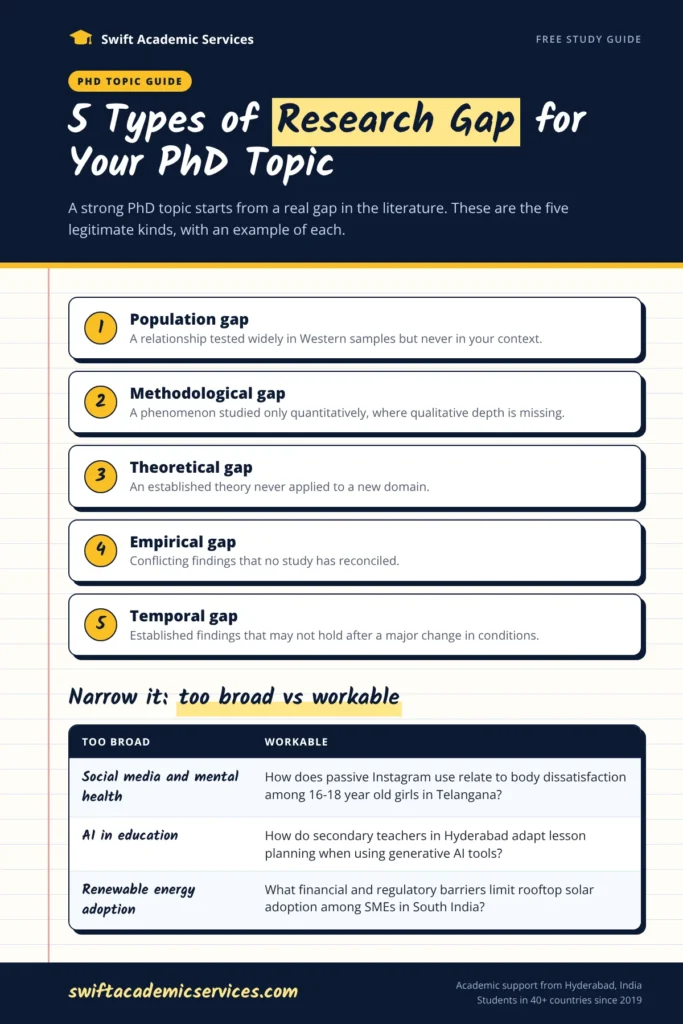
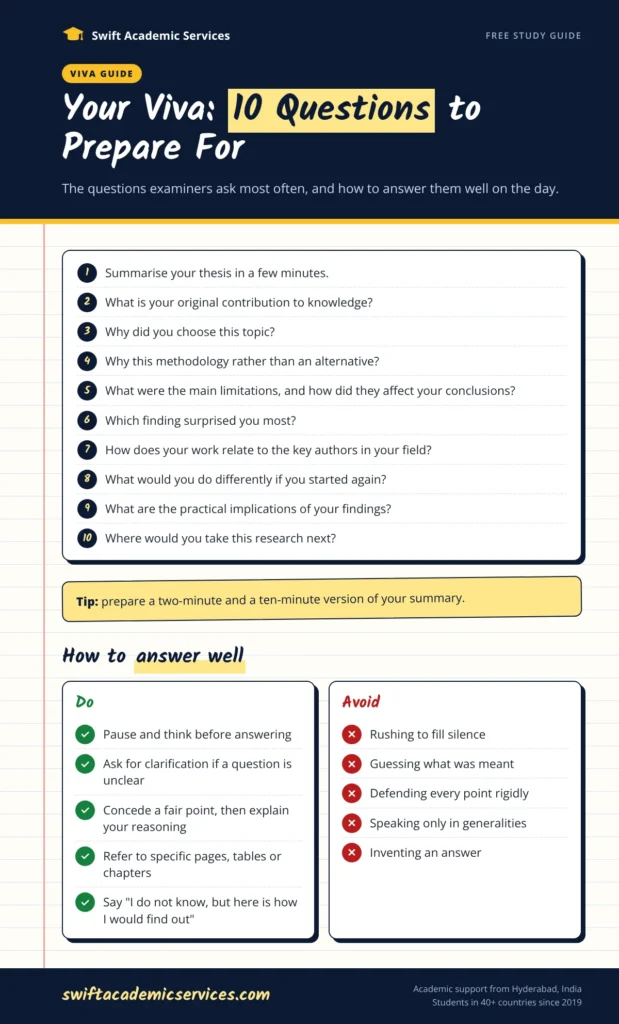
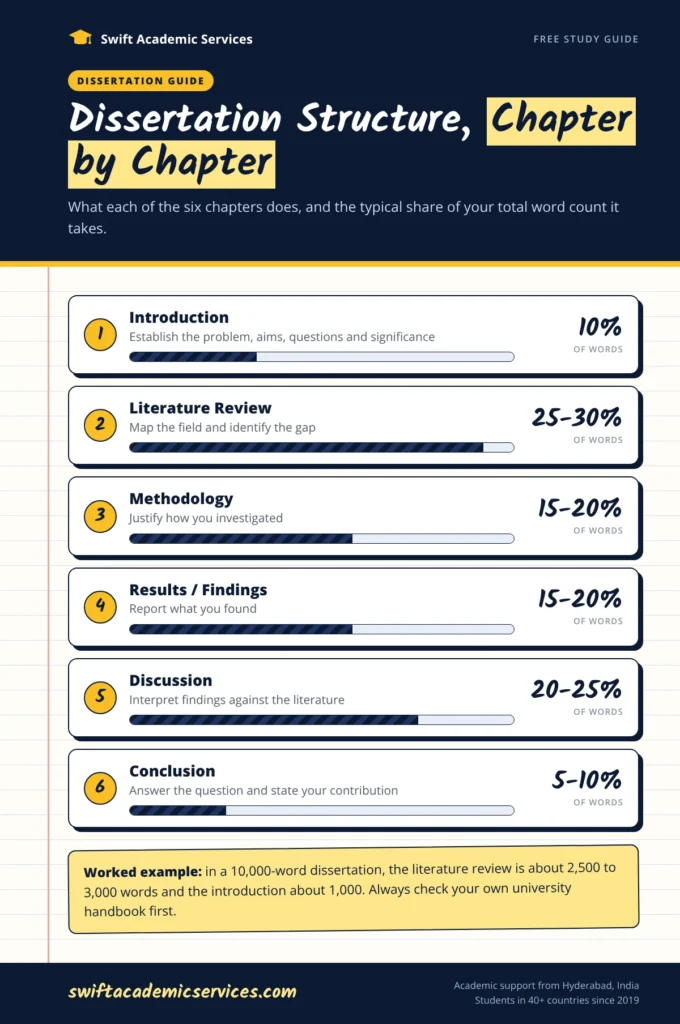
Home › Blog › Research & Thesis Research & Thesis PhD Synopsis Format for Indian Universities: Structure, Sections and Checklist By Mohd Shakeb · Updated 23 November 2026 · 8 min read Your PhD synopsis, also called the research proposal, is the first document your committee judges you on. It sets your topic, objectives and method for the next three years or more. This guide walks through the format Indian universities expect, section by section, with a checklist to run before you submit. Quick answer: A PhD synopsis in India usually contains a title, an introduction and background, a review of literature, the research gap, objectives, research questions or hypotheses, methodology, expected outcomes, a chapter plan, a timeline and references. Under the UGC PhD Regulations, 2022, your Research Advisory Committee reviews the proposal and finalises your topic, so always follow your university’s own format and page limit. What this guide covers What a PhD synopsis is and who approves it The standard synopsis format, section by section How to write the sections that matter most Formatting when your university gives no template Common reasons a synopsis is sent back Presenting your synopsis to the committee Quick answers to common questions Frequently Asked Questions What a PhD synopsis is and who approves it A PhD synopsis is a short, structured plan of the research you intend to do. It shows your committee that the topic is worth studying, that you know the existing literature, and that your method can answer your questions in the time available. Under the University Grants Commission (Minimum Standards and Procedures for Award of Ph.D. Degree) Regulations, 2022, notified on 7 November 2022, each scholar has a Research Advisory Committee, convened by the supervisor. One of its responsibilities is to review the research proposal and finalise the topic of research, and it also guides you on study design and methodology. Some universities call this body the Doctoral Committee or Departmental Research Committee. Some universities also ask for a final synopsis near the end of the PhD, a short summary of the completed thesis submitted before the thesis itself. This guide covers the proposal you write at the start. The standard synopsis format, section by section Universities word their headings differently, but almost every Indian PhD synopsis follows this order. Section What it should contain Title page Working title, your name, supervisor, department, university and month and year Introduction Background to the problem and why it matters now, in India and globally Review of literature Key studies grouped by theme, ending with what is still unknown Research gap One clear statement of the gap your study will fill Objectives Usually three to five specific, measurable objectives Research questions or hypotheses Questions for exploratory work, testable hypotheses for quantitative work Methodology Design, population and sample, data collection tools, analysis plan and ethics Significance and expected outcomes Who benefits from the findings and how Chapter plan A provisional outline of the thesis chapters Timeline Stages of the work mapped across your registration period References Every cited source, in one referencing style How to write the sections that matter most Title A good title names the main variables or concept, the population and the setting, for example a specific group of workers in a specific state. Avoid vague words such as “a study of” on their own. Review of literature and research gap Organise studies by theme rather than listing them one by one, and favour recent journal articles. Indian theses on Shodhganga, the INFLIBNET repository, are a useful way to check what has already been done at Indian universities. End the review with a short paragraph that states the gap in one or two sentences. Objectives Start each objective with an action verb, such as to examine, to assess, to compare or to develop, and make sure each one can be answered with the data you plan to collect. Methodology Every objective should map to a method. State your sample size and how you will select it, the tools you will use, such as a questionnaire, interviews or experiments, and the analysis you will run, for example regression in SPSS or thematic analysis in NVivo. Formatting when your university gives no template If your department provides a template, follow it exactly. If it does not, these common defaults are a safe starting point: A4 paper, 12-point Times New Roman, 1.5 line spacing, 1-inch margins, numbered headings and page numbers, with one referencing style, such as APA, used throughout. Keep it focused. A synopsis that states its gap, objectives and method clearly is stronger than a long one, and many universities set a page or word limit, so check yours before you start writing. Common reasons a synopsis is sent back The topic is too broad to finish within the PhD period Objectives are vague or cannot be measured The method does not match the objectives The literature is outdated or only descriptive, with no clear gap The similarity score is above your university’s limit; see our guide to UGC plagiarism levels References are incomplete or mix several styles Presenting your synopsis to the committee Most committees ask for a short presentation. Build a small set of slides covering the problem, gap, objectives, method and timeline, rehearse it aloud within the time you are given, and prepare for the questions committees ask most: why this topic, why this sample, why this method, and how the study adds something new. Key takeaways The synopsis is your research proposal: topic, gap, objectives and method Under the UGC 2022 PhD regulations, the Research Advisory Committee reviews it and finalises the topic Follow your university’s template and page limit first Every objective should map to a method and to the data you will collect Check similarity before you submit Quick answers to common questions What is the format of a PhD synopsis? A PhD synopsis usually follows this order: title page, introduction, review of literature, research gap, objectives, research questions or hypotheses, methodology, significance

PhD Synopsis Format for Indian Universities: Structure, Sections and Checklist Read More »
How Much Plagiarism Is Allowed in a Thesis in India? UGC Similarity Levels Explained

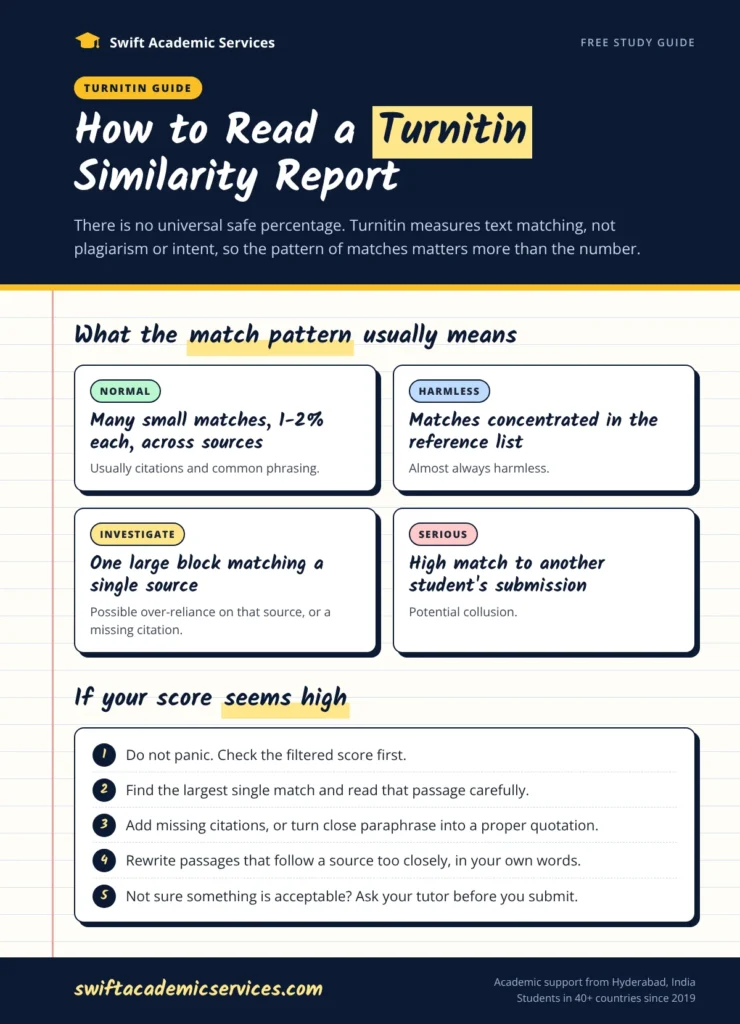
Home › Blog › Research & Thesis Research & Thesis How Much Plagiarism Is Allowed in a Thesis in India? UGC Similarity Levels Explained By Mohd Shakeb · Updated 23 November 2026 · 7 min read Every Indian university now runs theses and dissertations through plagiarism software before they go to examiners, and the percentage on that report decides what happens next. This guide explains the UGC similarity levels, what the check leaves out, and how to bring a high score down the honest way. Quick answer: Under the UGC (Promotion of Academic Integrity and Prevention of Plagiarism in Higher Educational Institutions) Regulations, 2018, up to 10% similarity in a thesis or dissertation is Level 0: minor, with no penalty. Above 10% to 40% (Level 1) means submitting a revised thesis within six months, above 40% to 60% (Level 2) means a one-year bar on resubmitting, and above 60% (Level 3) cancels registration. What this guide covers The four UGC plagiarism levels at a glance What the similarity check leaves out Is the 10% limit the same as your software score? What happens if your thesis is above 10% How to bring a high score down honestly Quick answers to common questions Frequently Asked Questions The four UGC plagiarism levels at a glance The UGC regulations sort similarity into four levels in rising order of seriousness, and set a different penalty for each. The thesis and dissertation penalties are the ones most students need to know. Level Similarity Penalty for a thesis or dissertation Level 0 Up to 10% Minor similarity, no penalty Level 1 Above 10% to 40% Submit a revised thesis within a stipulated period of no more than six months Level 2 Above 40% to 60% Barred from submitting a revised thesis for one year Level 3 Above 60% Registration for the programme is cancelled Repeat offences are treated one level more seriously than the previous offence. Separate penalties apply to faculty and researchers for research publications, starting with withdrawal of the manuscript at Level 1 and adding loss of annual increments and a bar on supervising new research students at Levels 2 and 3. Your university can set a stricter limit than the UGC. Always check your own university’s plagiarism policy or PhD ordinance before you submit. What the similarity check leaves out The regulations do not count every match. The following are excluded from the similarity percentage: Quoted work reproduced with permission or proper attribution References, bibliography, table of contents, preface and acknowledgements Generic terms, laws, standard symbols and standard equations The opposite applies to your core work. Your abstract, summary, hypotheses, observations, results, conclusions and recommendations are expected to be your own, so matches in those sections are taken more seriously than matches in your literature review. Is the 10% limit the same as your software score? Not automatically. Indian universities usually check theses with DrillBit or Turnitin, and the percentage those tools show depends on their settings. If the bibliography, quotations and small matches are not excluded, the report can show a higher figure than the one the regulations actually measure. Before you worry about a number, open the full report and check three things: whether references and quotations were excluded, which sources make up most of the score, and whether any match is your own earlier work, such as a published paper or a draft submitted before. Our guide to the Turnitin similarity score explains how to read a report line by line. What happens if your thesis is above 10% A high score starts a process; it does not decide the penalty on its own. Under the regulations, suspected plagiarism goes to the Departmental Academic Integrity Panel, which reports to the Institutional Academic Integrity Panel. Each panel has 45 days to report, and the student has the right to explain and defend the work before any penalty is imposed. Because many universities run the check before they accept a thesis for submission, a high score is often caught at that stage, and the scholar is asked to revise the thesis and check it again. How to bring a high score down honestly Check early. Run a similarity check on each chapter as you finish it, not on the full thesis the week before submission. Rewrite, do not disguise. Read the source, close it, and explain the idea in your own words with a citation. Paraphrasing tools and synonym swaps tend to produce awkward text, and many universities now run AI detection as well. Quote sparingly. Keep direct quotations for definitions and key statements, and put them in quotation marks with a citation. Cite your own work. Text reused from your own published papers still counts as a match unless it is cited and allowed by your university. Watch the methodology chapter. Standard descriptions of tests and tools often match other theses word for word. Describe what you actually did, in your own words. Get a final report. Check the complete thesis with the same tool your university uses before you submit. Key takeaways Up to 10% similarity is Level 0 under the UGC 2018 regulations: no penalty Above 10% to 40% means a revised thesis within six months References, bibliography, acknowledgements and properly attributed quotes are excluded Your abstract, results and conclusions are expected to be original Your university may set a stricter limit, so check its own policy Quick answers to common questions How much plagiarism is allowed in a PhD thesis in India? Up to 10% similarity is allowed under the UGC 2018 plagiarism regulations. That is Level 0, treated as minor with no penalty. Some universities set a stricter limit, and your core sections, such as the abstract, results and conclusions, are expected to have no copied text, so aim well below 10% overall. Is 15% plagiarism acceptable in a thesis? Under the UGC 2018 regulations, 15% falls in Level 1 (above 10% to 40%). If the integrity panel confirms it, the student is asked to submit

How Much Plagiarism Is Allowed in a Thesis in India? UGC Similarity Levels Explained Read More »

WhatsApp for a free quote Call