
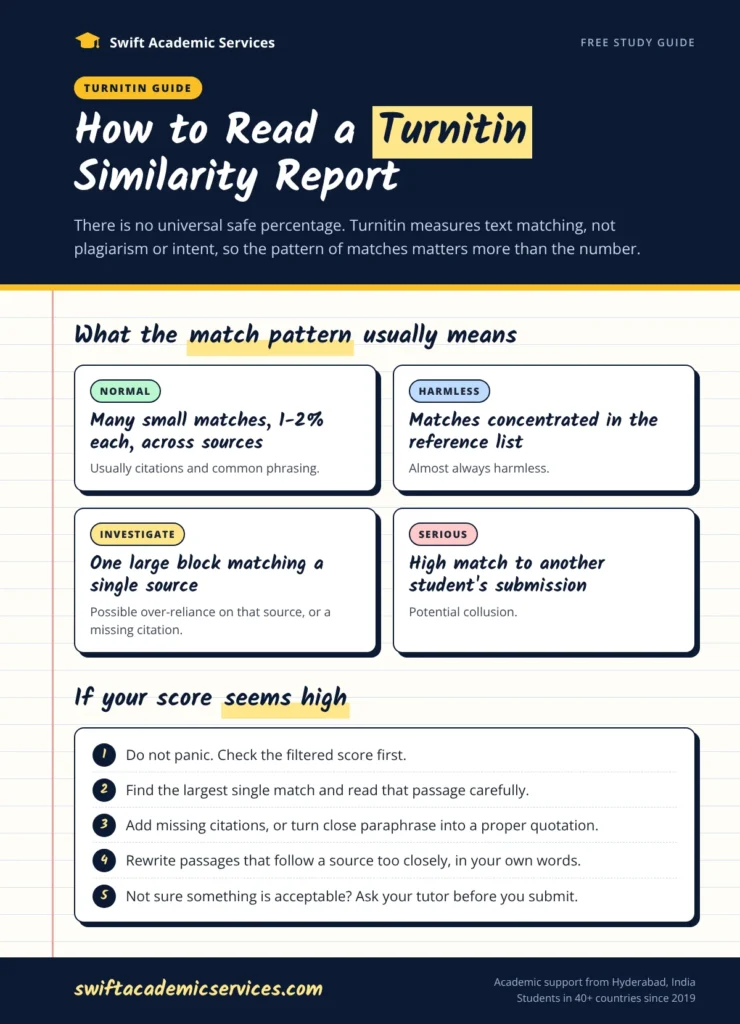
Students ask constantly: what similarity percentage is safe? The honest answer is that the number alone means very little. A 30% score can be perfectly fine and a 8% score can indicate serious misconduct. What matters is what is matching, and why.
Quick answer: A Turnitin similarity score is the percentage of your text that matches sources in Turnitin’s database. It is not a plagiarism verdict, because properly quoted and cited text also counts. There is no universal safe percentage: check your university’s threshold, look at which sources match and fix uncited or over-quoted passages. For Indian theses, UGC rules treat up to 10% as minor.
WhatsApp for a free quote
- What the score actually measures
- Why there is no universal safe percentage
- How to read the report properly
- How to reduce matches legitimately
- Paraphrasing tools and AI detection
- What to do if your score seems high
- How to read the AI writing report
- How reliable is the AI score?
- Similarity and AI scores are separate
- If your AI score seems wrong
- Quick answers to common questions

What the score actually measures
Turnitin is a text-matching tool, not a plagiarism detector. It compares your submission against a database of web pages, publications and previously submitted student work, then reports the proportion of your text that matches something else.
It cannot judge intent, and it cannot tell whether a match is properly cited. That judgement is made by a human marker reading the report.
Why there is no universal safe percentage
Legitimate matches inflate the number. These commonly include:
- Correctly quoted and cited material
- Your reference list, which matches thousands of other reference lists
- Standard technical or legal terminology
- Assignment title, headings and cover-page text
- Common methodological phrasing such as descriptions of standard instruments
A literature-heavy review with many short quotations may legitimately reach 25-30%. A reflective essay with 15% matching continuous prose from one uncited source is a far more serious problem.
| Report pattern | What it usually indicates |
|---|---|
| Many small matches, 1-2% each, across sources | Normal: usually citations and common phrasing |
| One large block matching a single source | Investigate: possible over-reliance or missing citation |
| High match to another student submission | Serious: potential collusion |
| Matches concentrated in the reference list | Almost always harmless |
How to read the report properly
- Open the similarity report rather than looking only at the headline percentage
- Use filters to exclude quotations and the bibliography, then recheck the score
- Examine each significant match individually
- For each, confirm there is an in-text citation and correct quotation marks where needed
- Look for long unbroken matched passages, which are the real warning sign
The filtered score, with quotes and bibliography excluded, is far more informative than the raw number.
How to reduce matches legitimately
The goal is not to disguise text so software misses it. That approach is both detectable and a serious integrity breach. The goal is genuinely original expression with proper attribution.
- Read a source, close it, then write the idea in your own words from memory and understanding
- Cite every idea you took from a source, whether quoted or paraphrased
- Reserve direct quotation for wording that genuinely matters; paraphrase the rest
- Restructure at sentence level, not just by swapping synonyms, synonym-swapping is still plagiarism
- Build arguments from multiple sources rather than following one closely
- Add your own analysis, which is inherently unmatched text
Paraphrasing tools and AI detection
Automated paraphrasing and “humanising” tools carry real risk. They often produce awkward text that markers notice, they do not add citations, and using them to disguise unoriginal work breaches academic integrity policies at virtually every institution.
Many institutions now also run AI-writing indicators alongside similarity checks. The safe and genuinely useful approach is to understand the material well enough to express it yourself, and to cite properly.
What to do if your score seems high
- Do not panic: check the filtered score first
- Identify the largest single match and read that passage carefully
- Add missing citations, or convert close paraphrase into quotation with attribution
- Rewrite passages that follow a source too closely, in your own words
- If you are unsure whether something is acceptable, ask your tutor before submitting
- Turnitin measures text matching, not plagiarism or intent
- No universal safe percentage exists: context decides
- Filter out quotes and the bibliography for a meaningful figure
- One long matched block matters far more than many tiny ones
- Understanding then rewriting beats any paraphrasing tool
How to read the Turnitin AI writing report
Many institutions now see a second report next to the similarity report: the AI writing report. It answers a different question. Instead of showing text that matches sources, it estimates how much of your prose looks as if a generative AI tool produced it. Turnitin says it splits a submission into overlapping segments of a few hundred words, scores each sentence between 0 and 1, and reports the share of qualifying prose sentences it predicts were AI-generated.
The AI report needs at least 300 words of prose in a long-form format. Lists, tables, code and very short answers are not treated as qualifying text, and documents that do not meet the requirements get a message instead of a score.
| What you see | What it means |
|---|---|
| A number from 20% to 100% | The model predicts that share of qualifying prose was AI-generated, and the flagged sentences are highlighted |
| *% | AI writing was detected somewhere between 1% and 19%; Turnitin shows no number and highlights nothing because low results are less reliable |
| 0% | No qualifying text was identified as likely AI-generated |
| AI detection unavailable | The file did not meet the requirements, such as length, language or format |
How reliable is the AI score?
Turnitin has reported a document-level false positive rate below 1 percent for documents with 20 percent or more AI writing, and a sentence-level rate of around 4 percent, meaning a small share of highlighted sentences may have been written by a person. It also found more false positives in the first and last few sentences of documents, and it describes the AI indicator as a data point to inform an educator’s judgement rather than a finding of misconduct.
Formal or formulaic writing, text heavily rewritten by editing tools and some second-language writing can be misread. Our guide on why human writing gets flagged as AI explains the causes and what to do.
Similarity and AI scores are separate
The two numbers are calculated independently. A document copied from published sources can have a high similarity score and no AI writing; text produced by an AI tool may match nothing, giving a low similarity score and a high AI score. Read each report for what it measures.
| Similarity report | AI writing report | |
|---|---|---|
| Measures | Text that matches other sources | Prose that looks AI-generated |
| Shows | Matched sources and highlighted passages | Highlighted sentences, or *% below 20% |
| Evidence | A source anyone can check | A statistical prediction |
| Fix if needed | Citations, quotation marks and your own wording | Evidence of your process; honest disclosure if AI was used |
More detail: AI detection vs plagiarism checking.
If your AI score seems wrong
- Keep the submitted version as it is; do not run it through a paraphrasing tool
- Note which sentences are highlighted and the overall result
- Gather drafts, version history, notes and the sources you read
- List any tools you used, such as grammar or translation tools
- Read your institution’s AI policy and how it uses AI reports
- Explain calmly how you planned, researched and wrote the work
Want someone to read the report with you? See AI report review, or get a fresh report from our Turnitin report services, run with no repository.
Quick answers to common questions
Is 25% on Turnitin too high?
Not necessarily. The similarity score shows matching text, not plagiarism. 25% can be fine if most of it is correctly quoted and cited material, your reference list or common phrases, and a problem if it comes from one source or from uncited copying. Check what matches, and your university’s own threshold, before worrying.
Is 30% similarity bad on Turnitin?
It depends on what makes up the 30%. There is no universal cut-off, so look at the largest matching sources first. For theses and dissertations in India, the UGC 2018 regulations treat anything above 10% and up to 40% as Level 1, which means the student must submit a revised script within six months.
Is a 47% Turnitin score bad?
A 47% score almost always needs attention. It usually means long passages match other sources, or that an earlier draft of your own work is already in Turnitin’s database. For Indian theses it falls in the UGC Level 2 band (above 40% to 60%), where a revised script cannot be submitted for one year.
Is 40% similarity on Turnitin bad?
40% is high for most assignments and theses. Check which sources make up the score: if one source dominates, you may have relied on it too heavily, or a previous submission of your own is matching. Under India’s UGC 2018 regulations, 40% is still Level 1, which requires a revised script.
Frequently Asked Questions
Is 20% similarity too high?
Does Turnitin detect paraphrasing?
Do quotations count towards the similarity score?
Will citing sources reduce my similarity score?
Can I check my work before submitting?
What does *% mean on a Turnitin AI report?
Is the Turnitin AI score the same as the similarity score?
Can the Turnitin AI score be wrong?
How many words does Turnitin need to check for AI writing?
Want an originality check before you submit?
We run similarity analysis and show you exactly where citation or rewriting is needed, so you submit with confidence in your own work.
💬 Get Free ConsultationContact UsMore on similarity and AI reports
Guides and services for reading and acting on your report.
Related thesis guides and services
Continue with these pages.