

Two students write equally intelligent essays. One scores 58, the other 74. The difference is usually not ability, it is that one wrote to the rubric and the other wrote to the topic. Here is how to decode the grid your marker actually uses.
Quick answer: Read a marking rubric row by row: each row is a criterion with a weighting, and each column describes what work at that grade looks like. Find the band you are aiming for, note the exact words it uses, such as critical or synthesised, and check that your draft shows each one, starting with the most heavily weighted criteria.
WhatsApp for a free quote
What a rubric really tells you
A rubric is not administrative paperwork. It is your marker thinking out loud about where marks come from, published in advance. Ignoring it is like sitting an exam without reading the questions.
Most rubrics contain three things: criteria (what is assessed), weightings (how much each is worth), and grade descriptors (what each standard looks like in practice).
Follow the weightings, not your interests
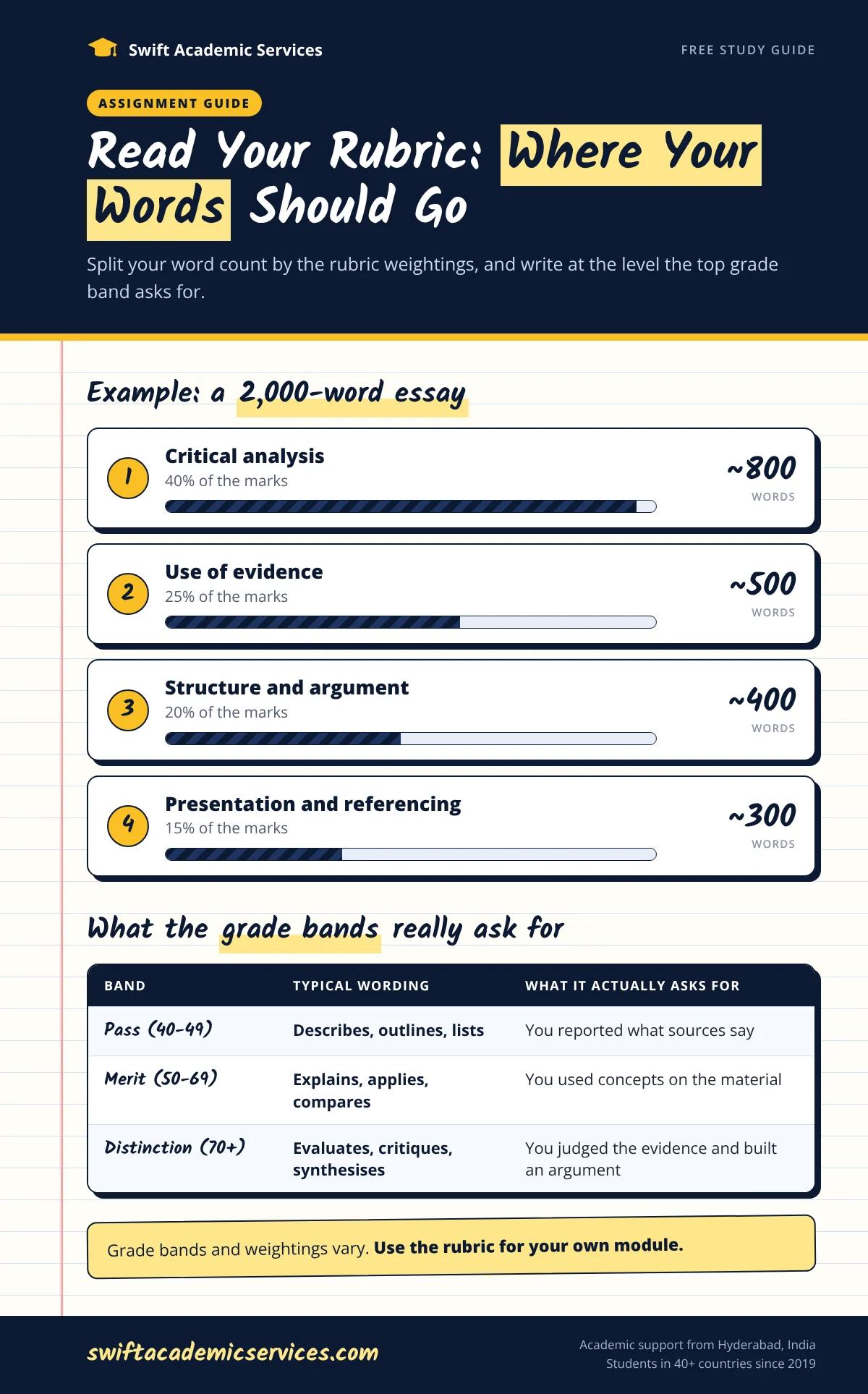
Students consistently over-invest in the parts they enjoy. If “critical analysis” carries 40% and “background context” carries 10%, but you wrote six pages of history and two of analysis, you have optimised for the wrong thing.
| Criterion | Weight | Words in a 2,000-word essay |
|---|---|---|
| Critical analysis | 40% | ~800 |
| Use of evidence | 25% | ~500 |
| Structure & argument | 20% | ~400 |
| Presentation & referencing | 15% | ~300 |
This is a rough allocation rather than a rule, but it exposes imbalance fast. Draft your plan against the weightings before writing.
Decode the grade band language
Rubric wording is precise, and the verbs matter. The jump between bands is almost always a jump in cognitive demand, not in word count.
| Band | Typical wording | What it actually asks for |
|---|---|---|
| Pass (40-49) | Describes, outlines, lists | You reported what sources say |
| Merit (50-69) | Explains, applies, compares | You used concepts on the material |
| Distinction (70+) | Evaluates, critiques, synthesises | You judged the evidence and built an argument |
Turn the rubric into a checklist before you write
- Copy the criteria into a blank document
- Under each, write one sentence describing how your assignment will satisfy it
- Note the weighting and set a rough word budget
- Write your plan from this document, not from the topic title
- After drafting, tick each criterion off against the actual text
This takes twenty minutes and routinely moves work up a band, because it eliminates the most common failure: answering a related question rather than the set one.
Read the verb in the question too
- Discuss: present multiple perspectives and weigh them
- Critically evaluate: judge strengths and weaknesses, reach a position
- Compare and contrast: identify similarities AND differences systematically
- Analyse: break into components and examine relationships
- Describe: report features accurately (usually lower-band on its own)
A “critically evaluate” question answered descriptively caps your mark regardless of how well written it is.
Use feedback as a rubric for next time
Feedback almost always maps back to rubric criteria. If a marker writes “more critical engagement needed”, that is the analysis criterion. Keep a running list of recurring comments; that list becomes your personal pre-submission checklist.
- Allocate words in proportion to criterion weightings
- Higher bands demand evaluation and synthesis, not more description
- Build a rubric checklist before writing, and tick it off after drafting
- The verb in the question sets the cognitive level required
- Recurring feedback comments reveal your personal weak criteria
Quick answers to common questions
How do you read a rubric?
Read across each row: the row names a criterion, such as argument or referencing, and the columns describe what that criterion looks like at each grade. Note the weighting of each criterion, find the band you are aiming for, and treat its wording as a checklist for your draft.
How does a marking rubric work?
A rubric breaks the assessment into criteria, gives each one a weighting and describes performance at each grade band. Markers place your work in a band for every criterion and combine those, using the weightings, into your final mark. That is why a weak heavily weighted criterion costs more than a weak minor one.
How can I use a rubric to improve my grade?
Before writing, turn each criterion into a heading or checklist item. After drafting, highlight where each criterion is met and compare your work with the wording of the next band up. Fix the most heavily weighted gaps first, and ask your tutor what a top-band answer looks like if the wording is vague.
Frequently Asked Questions
What if my course does not provide a rubric?
Should I use rubric wording in my assignment?
Why did I lose marks when I answered everything?
How much does presentation and referencing really matter?
Not sure your work matches the rubric?
Our tutors map your assignment to the exact criteria your marker will use, and show you where the marks actually are.
💬 Get Free ConsultationContact Us